
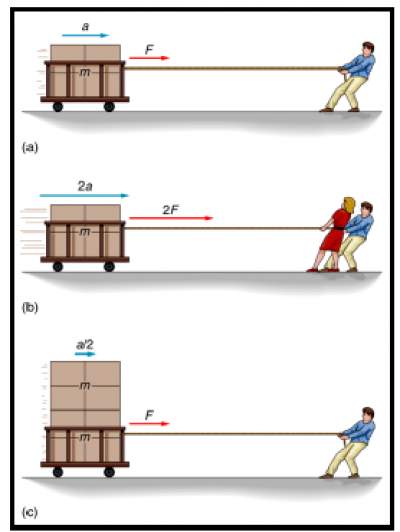



A: Newton's Second Law states that the acceleration of an object is directly proportional to the net force acting on it and inversely proportional to its mass.
It is expressed by the formula: F = m × a, where F is force in Newtons, m is mass in kilograms, and a is acceleration in metres per second squared.
A: If the mass stays the same and the force is doubled, the acceleration doubles as well.
This is because acceleration is directly proportional to force according to Newton's Second Law.
A: Mass is the measure of how much matter an object contains and is measured in kilograms (kg).
Weight is the gravitational force acting on that mass and is measured in Newtons (N). In the absence of gravity, an object would have no weight, but its mass remains the same.
A: Inertia is an object's resistance to a change in its motion.
Mass is a measure of inertia — the greater the mass, the greater the force needed to accelerate it.
A: Net force is the overall force acting on an object after all individual forces have been added together as vectors, taking direction into account.
If forces act in opposite directions, the smaller force is subtracted from the larger one to find the net force.
A: One Newton is defined as the force needed to accelerate a mass of 1 kilogram at a rate of 1 metre per second squared. In units: 1 N = 1 kg·m/s².