\[ F(s) = \int_{0}^{\infty} f(t)e^{-st}\,dt \]
\[ F(s) = \mathcal{L}\{f(t)\} \]
\[ f(t) = \mathcal{L}^{-1}\{F(s)\} \]
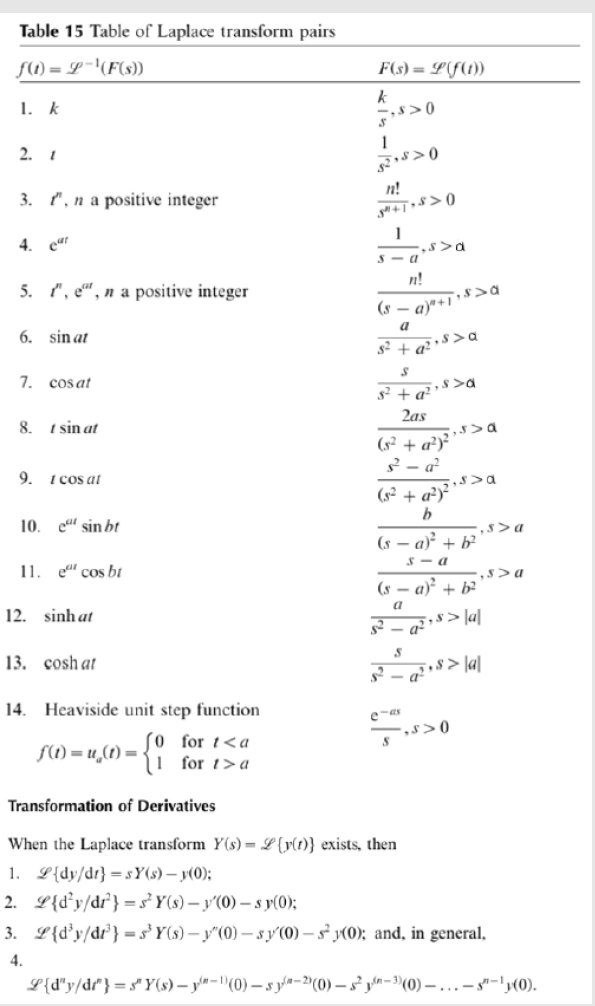
A: The Laplace Transform converts a function of time, f(t), into a function of a complex variable s, written as F(s).
It is defined by the integral \( F(s) = \int_0^\infty f(t) e^{-st} \, dt \). It is widely used in engineering and mathematics to simplify the process of solving differential equations.
A: The Laplace Transform converts differential equations into algebraic equations, which are much easier to solve.
After solving in the s-domain, the Inverse Laplace Transform converts the result back into a function of time.
A: The Inverse Laplace Transform converts a function in the s-domain, F(s), back into a function of time, f(t).
It is written as f(t) = ℒ⁻¹{F(s)} and is typically evaluated using a table of standard Laplace Transform pairs.
A: Apply the Laplace Transform to both sides of the equation to convert it into an algebraic equation in s.
Substitute the initial conditions, solve for F(s), then apply the Inverse Laplace Transform to find f(t).
A: Partial fraction decomposition breaks a complex rational expression in s into simpler fractions that match standard Laplace Transform pairs from a table.
This makes it possible to apply the Inverse Laplace Transform to each term individually.